Latest
March 6, 2026
"Feel afraid and do it anyway": Newhaul's Kim Lantsbery on Leadership in Logistics
Culture, Team
Latest
March 6, 2026
On International Women’s Day, we celebrate the women shaping industries, challenging perceptions, and building pathways for the next generation.
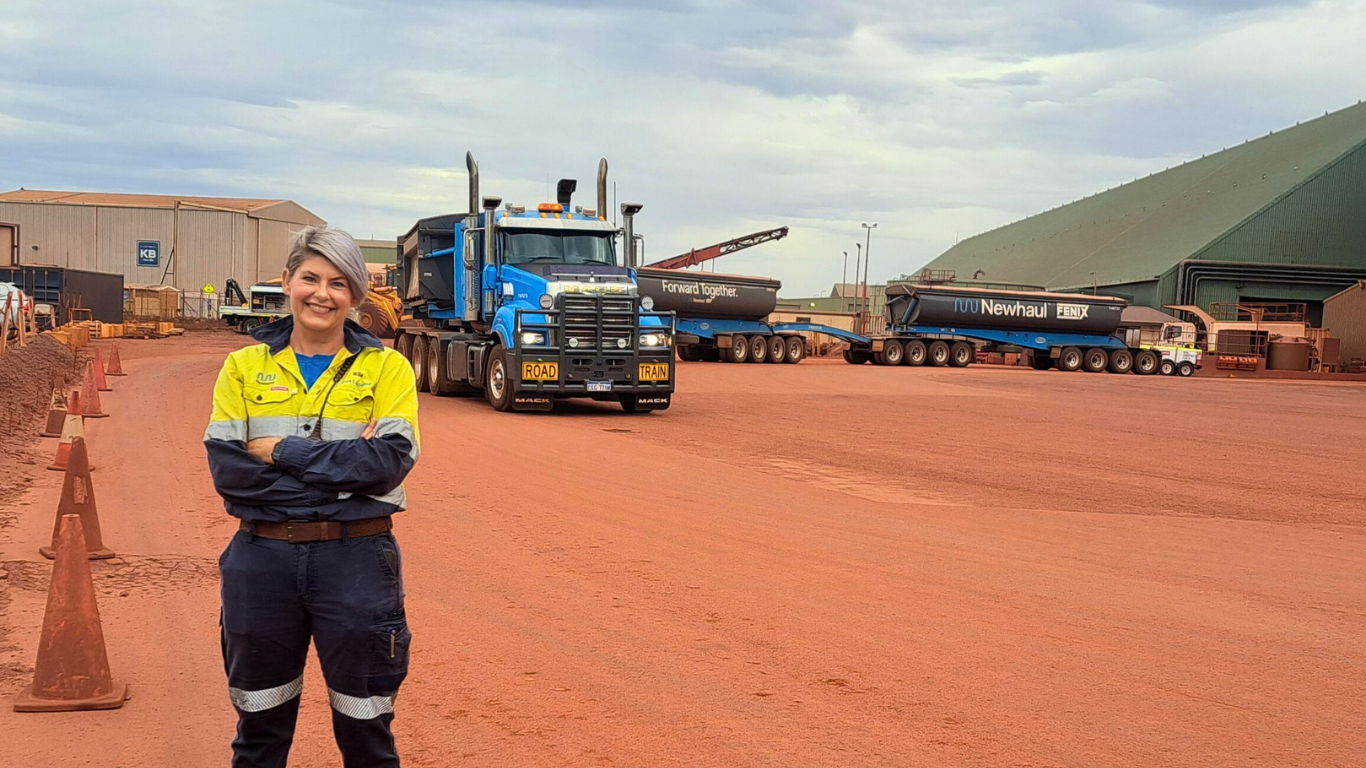
The Mining and Logistics Industry hasn’t traditionally been seen as a place for women, especially in Port environments, where in 2026, women make up less than a quarter of the workforce. It’s operational, fast-paced, high-pressure, and historically male-dominated. But leaders like Kim Lanstbery, Newhaul Port Superintendent, are redefining what female leadership in this environment looks like.
Port Operations might not be the first career path young women imagine for themselves, but for Superintendent Kim, this world has always felt familiar.
“My Dad was in the British Navy, so I pretty much grew up in an aircraft hangar – noise, oil, dirt. Not too much has changed really, just the mode of transport!”
Her career has moved through nearly every mode of transport – planes, trains, and now trucks and ships. Starting out in dispatch in Newcastle International Airport in the UK while studying for her first degree., she later worked with Virgin Trains. A planned move into the police or fire service was put on hold when an opportunity to relocate to Australia in 2011 proved too good to pass up.
What was meant to be temporary became transformational. Joining the original team tasked with creating a secure terminal and building structures at Mid West Ports during the Iron Ore boom, Kim progressed through several leadership positions before covering the Operations Superintendent role. Seeking a new challenge, she moved to Newhaul in 2025: "I love to learn – there is always something new, no matter how long you’ve been in a job. I’ve taken the opportunity to train and develop wherever I can, even when it’s been well out of my comfort zone.”
Across 13 years in WA’s Port Operations, for Kim, one belief has remained constant: “Feel afraid and do it anyway”.
When asked about defining moments in her career, Kim doesn’t point to a promotion or project milestone.
“I became a Mum”.
Motherhood reshaped her communication style and leadership perspective, “It changed how I communicate in every way – understanding that not everything has a solution that’s clearly visible or standard. My kids taught me to adapt efficiently and recognise that failures are not always negative.”
Adaptability, patience and perspective became central to how she leads, with skills that translate powerfully into operational environments where no two days look the same.
Building a career in port operations hasn’t been without its frustrations.
“If you make the effort, take time to learn, develop relationships and be part of the team (good bits and bad bits) then you’ll have value, regardless of being female or male. I’ve held myself to that standard my entire career.”
That said, she acknowledges the reality many women understand: “Having to prove your own capability before being accepted.”
Holding people accountable and challenging behaviours in male-dominated environments required skill development. “There’s a fine line between addressing issues and navigating ego. I’m far less inclined now to soften the message unnecessarily. It’s about understanding the dynamics in the room – who holds influence and why.”
And sometimes, the challenges are more practical, “women’s PPE shirts are dreadful for women who climb in and out of equipment or up ladders!”
.png)
Kim is thoughtful when asked about the strengths women bring to operational environments: “I think many women naturally lean into understanding the ‘why’ behind the process, not just executing it.” When things go wrong, she sees a willingness to reassess and adapt. “There’s less rigidity around ‘this is how it’s always been done’ and more willingness to find solutions.”
But she’s clear: it’s not about better or worse. “It’s that women operate differently to men. And ‘different’ makes teams stronger.”
Kim describes herself simply: “I am a human human.”
She believes high-performing teams are built on respect, trust and a sense of shared purpose. “The best teams often don’t even realise how they became strong. It just happens. Doing good things without fanfare is what binds a team together. You don’t match noise with noise.”
Her leadership approach centres on truly seeing people, understanding both strengths and areas to improve, and having the uncomfortable conversations when necessary.
“Sometimes people feel overlooked. Sometimes others question why someone is being given a chance. My job is to look at their potential objectively and back it, even if it challenges perceptions.”
When asked about making space for more women in operational roles, Kim offers a subtle but powerful reframing.
“The space is already there. It’s more about continuing to challenge perception and recognising the value that’s already present.”
Her approach to mentoring is consistent with how she leads anyone stepping into something new: “build confidence in capability.”
Not differently. Not separately. Just equitably.
Kim feels most proud not of titles, but of trust. “I feel most proud when people seek out my time or advice, especially when the relationship may have started in a tough or complex place.”
And if she could say something to her younger self?
“Not everyone needs to understand you straight away. Trust your instincts. You’ll be right more often than you give yourself credit for. And you won’t always feel ready. Do it anyway.”
For the next generation of women in Port Operations, Kim hopes for earlier clarity in career pathways and a continued shift in perception.
Her message to women considering the industry is simple and strong: “Ask the questions others avoid. Challenge ‘that’s how we’ve always done it.’ Respect experience – but don’t be intimidated by it.”
International Women’s Day is about recognising progress, acknowledging challenges, and committing to continued growth.
Leaders like Kim remind us that change doesn’t always arrive loudly. Sometimes it looks like consistency. Accountability. Curiosity. Backing potential. Challenging assumptions. Showing up, day after day.
And sometimes, it looks like simply doing it anyway.